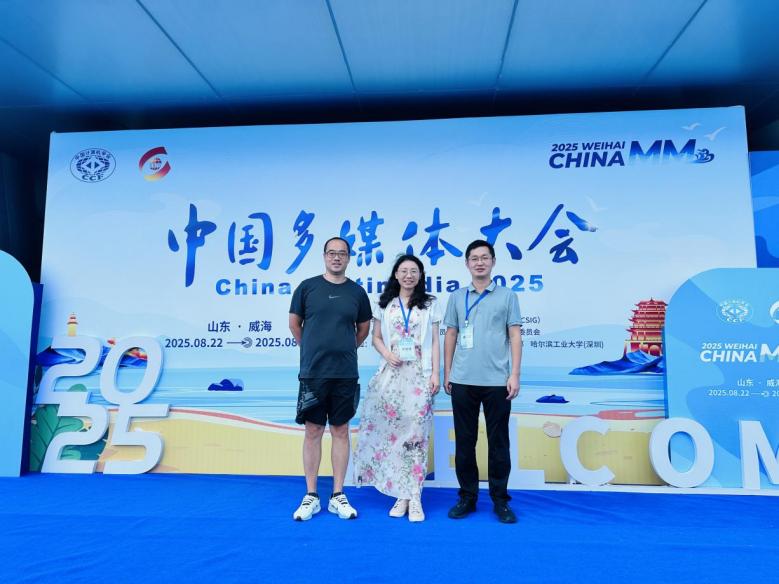
From August 22 to 24, 2025, the highly anticipated China Multimedia Conference was grandly held in Weihai, Shandong. Professor Li Yuanyuan, Dean of the School, led the delegation, accompanied by Yu Lei, Secretary of the Party Branch of the Computer Science Department, and Shang Xiwu from the Department of Electronic Information. At the conference, the research findings of Wang Jiajia, a graduate student of the School, were presented and exchanged in the form of a paper poster, demonstrating the School's achievements in talent cultivation and scientific research exploration in the field of multimedia technology.
The China Multimedia Conference is one of the largest academic conferences in the multimedia field in China. It is organized by the China Computer Federation (CCF) and the Chinese Society of Image and Graphics (CSIG), and hosted by the CCF Technical Committee on Multimedia Technology and the CSIG Technical Committee on Multimedia. The conference brought together top experts, scholars, and technical professionals from universities, research institutions, and enterprises across the country.
This participation served as a routine initiative by the School of Electronic and Electrical Engineering to promote academic exchange and advance disciplinary development. The presented paper, titled "MSTF-Net: A Multi-Scale Transformer and Frequency-Spatial Fusion Network for Compressed Video Frame Quality Enhancement," focuses on the field of video enhancement research. It addresses the issue of video quality degradation caused by high compression under standards like H.266/VVC, as well as the limitations of existing deep learning methods, which often overemphasize spatial features while neglecting global temporal structural information, making it difficult to restore complex texture details. The research team proposed a Multi-scale Transformer and Frequency-Spatial Fusion Network (MSTF-Net). This framework utilizes a CNN-Transformer backbone to extract features from degraded frames, followed by a Frequency-Spatial Feature Fusion Module (FSFFM) that leverages global frequency-domain information to guide the enhancement of local spatial features. Combined with a perceptual alignment loss function to optimize the network, it forms a collaborative optimization mechanism.
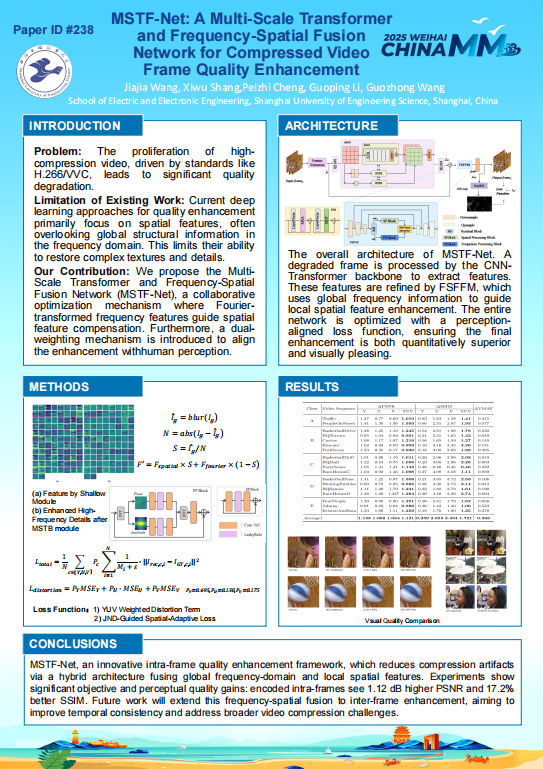
The framework employs a dual-weighting mechanism that utilizes frequency-domain features derived from Fourier transform to guide the compensation of spatial features. The loss function incorporates a YUV-weighted distortion term and a spatially adaptive loss guided by a just-noticeable-difference (JND) model, ensuring excellent performance in both quantitative metrics and visual perception. As an intra-frame quality enhancement framework, MSTF-Net effectively reduces compression artifacts by integrating global frequency-domain and local spatial features. Future work aims to extend the frequency-spatial fusion mechanism to inter-frame enhancement to improve temporal consistency in videos and address a broader range of video compression challenges.
The School's participation in this multimedia conference to present and exchange these research results not only affirms our institution's scientific research capabilities but also demonstrates our active integration into the domestic academic community and commitment to promoting disciplinary development. Taking this opportunity, the School will further cultivate a conducive research environment, encourage faculty to engage in scientific innovation, and provide solid support for cultivating high-quality talent and serving societal development.


